The last few postings here have been about rather technical problems with the conventional understanding of how spacetime symmetries and Wick rotation work in the Standard Model. These were written partly because I think these problems deserve to be better known, partly because they motivate a different way of thinking about spacetime symmetries which doesn’t have these problems. This different point of view is that of Penrose’s twistor theory, supplemented by the consideration of the Wick rotation issue, something that I haven’t seen addressed elsewhere in the literature about twistors.
In this posting I’d like to outline the ideas about twistors and unification that I’ve been thinking about for quite a few years now. I’ve been making slow progress at better understanding the details of how to make this work, with still a lot to be done. As this has been going on, I’ve become more and more optimistic that this makes sense and is a very fruitful research direction. I also remain very much struck by the beauty of this framework and its deep connections to fundamental mathematical ideas. In this day and age, Dirac’s argument that
It seems that if one is working from the point of view of getting beauty in one’s equations, and if one has really a sound insight, one is on a sure line of progress.
has become very unpopular (due to people with an ugly and incoherent 11 dimensional theory hyping it as beautiful or “elegant”). In an environment with no hints coming in from experiment, it could be our only hope.
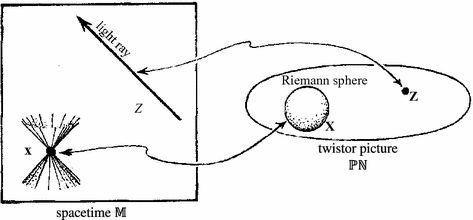
The twistor point of view fits perfectly with the “spacetime is right-handed” slogan. It is inherently chiral, something that Penrose saw as a problem (the “googly problem”) since he wanted parity-invariant gravity, but that seems to me a virtue. The fundamental spacetime structure is a complex three dimensional space $PT$, which breaks up into two pieces $PT^+$ and $PT^-$, with a common five real dimensional boundary, $N$. Minkowski space time is defined in terms of $N$ (all $\mathbf CP^1$s inside $N$). The fundamental fact behind Wick rotation (that time dependence breaks up into positive and negative energy pieces, corresponding to holomorphicity in the upper or lower half place) in twistor theory appears as the fact that dependence on Minkowski spacetime (in the form of $N$) breaks up into pieces holomorphic in $PT^+$ and holomorphic in $PT^-$ (with boundary data hyperfunctions on N).
As discussed in the last posting, one can think of $PT$ as the standard $\mathbf CP^3$, with an $SU(2,2)$ action. This gives a generalization of Minkowski spacetime with a larger symmetry group, the conformal group, replacing the Poincare group. Elementary particles correspond to representations of this group. To get a gravity theory, one needs to abandon this global symmetry, and think about a holomorphic theory of $\mathbf CP^1$s embedded in a more general complex three dimensional object. I won’t here go further into the issue of how to get quantum gravity this way, but I think this is a more promising starting point than any of the currently popular ones.
In QM, “Wick rotation” is what happens when you decide to study something holomorphic in the upper half complex time plane not by looking at its hyperfunction boundary values on the real time axis, but by restricting to the positive imaginary axis and studying the real analytic restriction there. Analogously, “Wick rotation” in twistor theory is what happens when one picks a fibration of $PT$ by $\mathbf CP^1$s in a way that gives an imaginary time direction (the direction normal to the threereal dimensional family of fibers of the fibration restricted to $N$).
Recently my point of view about all this has changed a bit. I started by thinking that what one wanted to take as fundamental was the Euclidean spacetime twistor picture (thus “Euclidean Twistor Unification”), where $PT$ is the space of complex structures on the tangent spaces of the four-dimensional real space-time. Then Minkowski space-time is a derived object you get once you pick an imaginary time direction and Wick rotate. More recently I’ve found it useful to think of the Minkowski twistor point of view outlined above as fundamental, with “Wick rotation” what happens when you decide you don’t want to deal directly with hyperfunction boundary values, but would rather pick an arbitrary direction normal to the boundary and look at real analytic values restricted to a coordinate in this direction.
From this second point of view, when one Wick rotates, one is making something like a choice of gauge. The twistor point of view treats the $SL(2,\mathbf C)_R$ and $SL(2,\mathbf C)_L$ local symmetries very differently. The $SL(2,\mathbf C)_R$ is what acts on the $\mathbf CP^1$s that describe points. The $SL(2,\mathbf C)_L$ locally acts on the tangent space to the space parametrizing the $\mathbf CP^1$s. When you Wick rotate, you break that symmetry. From the Wick rotated Euclidean point of view, only an $SU(2)_L\subset SL(2,\mathbf C)_L$ acts. From the Minkowski spacetime point of view this symmetry is an internal symmetry, spontaneously broken by your choice of how to do the Wick rotation.
To get the Standard Model using these ideas, one thing one needs to do is work out a consistent formalism based on the above, that looks like the standard electroweak theory with the Higgs when written down in terms of the usual spacetime description. I don’t at this point know how to do this, but it is not obvious that something like this can’t be done.
Part of the twistor picture, as explained in the last posting, has always been that one could understand the solutions to the Weyl equation in terms of sections of a holomorphic line bundle over $PT^+$ (the “Penrose transform”). To understand gauge fields satisfying the self-duality equation, one can use holomorphic vector bundles over $PT^+$ (the “Penrose-Ward correspondence”, although this is somewhat different). These include the tangent bundle, on which the $SL(2,\mathbf C)_R$ will act along the fibers, and the $SU(2)_L$ will act as described above (details to be sorted out…). Above $\mathbf CP^3$ there’s a canonical line bundle and a three complex dimensional quotient bundle, with a $U(1)\times U(3)$ local symmetry. That you’re on $\mathbf CP^3$ means you’ve modded out a $U(1)$, so have the Standard Model $U(1)\times SU(3)$.
Matter fields will be described in terms of holomorphic sections of these holomorphic bundles over $PT^+$. Their couplings to gauge fields will be described, at least in the self-dual case, by the holomorphic structure of the bundles. I don’t have details worked out, but it seems that you can perhaps write down all this using something like a Dolbeault operator on $PT^+$ for these various holomorphic bundles. Or, perhaps you should look at a Dirac operator instead of the Dolbeault operator? How do generations appear?
The above should give some idea of what I’ve been thinking about. There’s a huge amount of challenging work to be done in terms of reformulating conventional ideas about quantum field theory in a consistent holomorphic formalism that implements the above general picture. Personally I think all of this is vastly more promising and interesting than the currently popular but moribund research programs that try and improve on the Standard Model and quantize gravity. I’ll keep at the project of getting more details written down as I understand them, but this is slow going and it’s very unclear what parts to write up since, honestly, just about no one else seems interested in any of it.
I’m no longer teaching, so have more time to work on this, and more time to travel. The week after next I’ll be in Paris, after that will spend a couple more weeks traveling in Europe, details still up in the air. If you understand some of the above and would like to hear more about it, contact me and maybe my travel plans can include a visit. By mid-April, I’ll be back in New York, only definite travel plan after that to get to Madrid around August 12 and see the solar eclipse visible from near there.